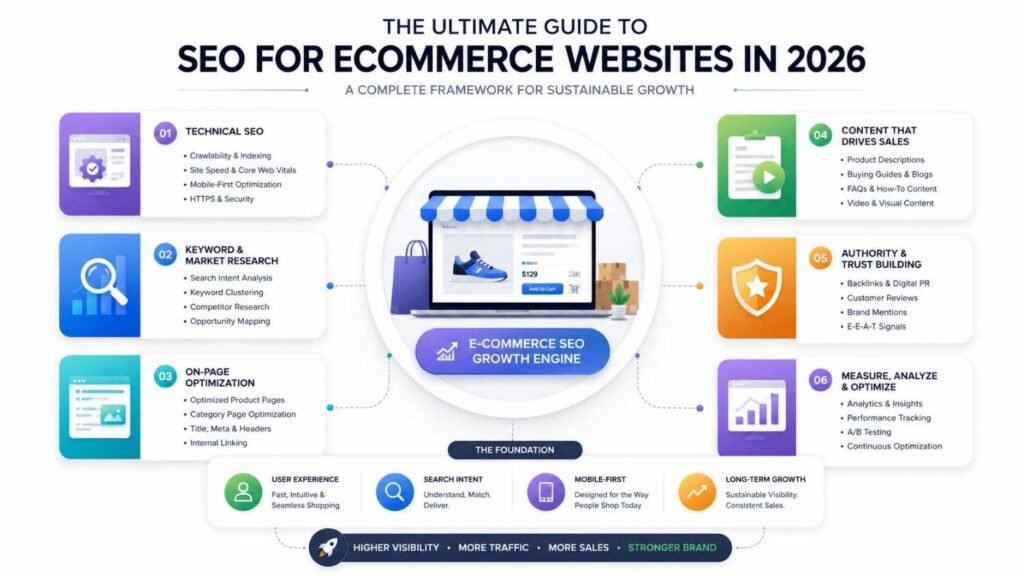
If you’re running an online store and not investing in SEO for Ecommerce Websites, you’re leaving money on the table — consistently, every single month. I’ve spent three years doing SEO for ecommerce websites for businesses across Shopify, WooCommerce, and niche D2C brands, and the one thing I can tell you with certainty is this: the stores that grow organically aren’t the ones with the biggest ad budgets. They’re the ones that treat SEO for ecommerce websites as an ongoing strategy, not a one-time setup.
This guide covers everything you need to build, optimize, and sustain organic visibility for your ecommerce store in 2026 — from the technical foundation to category pages, product pages, content strategy, and the AI search landscape that’s changing how discovery works.
The Big Mistake Most Ecommerce Stores Make First in SEO For Ecommerce Websites
Before we start talking about what to do we need to talk about the mistake that a lot of ecommerce stores are still making in 2026. This mistake is thinking that search engine optimization is something you can just set up one time and then forget about it.
A lot of store owners will put an SEO plugin on their website add some titles to the front page of their website and then they think they are all done with search engine optimization.
The foundation is really important. Each layer of something depends on the layer that’s, below it. I always check the foundation. Make sure it is okay before I do anything else to the other layers. The foundation has to be solid or nothing else will work right. I fix the foundation first. Then I can work on the other layers of the thing.
Layer 1: Build a Strong Technical Base
Technical SEO is not exciting. It is where most SEO for ecommerce websites successes come from at the start. I recall working on a store that had good products and a decent domain but almost no organic traffic. A technical check showed crawl problems, page loads and duplicate content across many URLs. Before changing any content I focused on fixing those issues improving site structure and adding data.
Within a months several target keywords moved to the first page of Google and organic sales improved significantly. The products did not change. The site just became something Google could understand and trust.
Key technical areas to check in SEO for ecommerce websites:
* Crawlability and indexation-Use Google Search Console to find pages that are not being crawled or indexed correctly.
* Site speed and Core Web Vitals-Slow sites lose rankings and customers. Compress images, use caching and remove scripts.
* Usability-Most ecommerce traffic comes from mobile. If your site does not work well on a phone that is both a user experience and ranking problem.
* Duplicate content-Ecommerce sites often have this issue because of filtered URLs, pagination and products in categories.
Dealing with Duplicate Content
Faceted navigation is one of the duplicate content challenges in ecommerce. My approach is to assess each case rather than applying a general fix.
If a filtered URL, such as /shoes?color=does not have significant search demand I prevent it from being indexed.. If it targets a real search query like “black running shoes for women ” I treat it as a standalone landing page and optimize it accordingly. That difference alone has opened up ranking opportunities that competitors were ignoring.
For products in categories canonical tags tell search engines which URL is the main version. For pagination I keep pages crawlable so Google can find all your products. I do not force pages to point back, to page one.
Layer 2: Make Category Pages Better for People Who Want to Buy
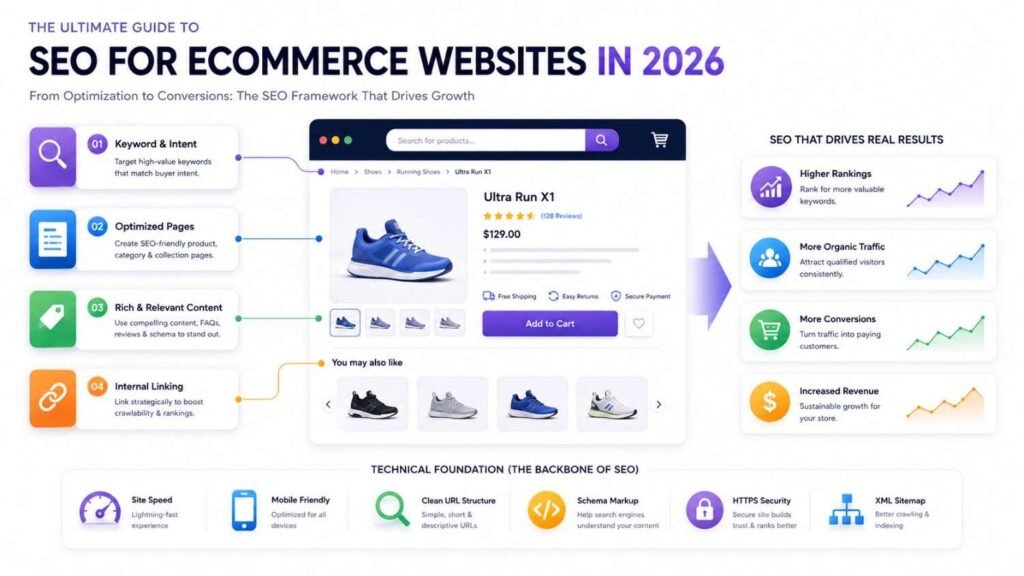
If I had to choose one thing that makes the difference in SEO for ecommerce websites it is making category pages better. And most stores do not do enough to make them good.
Category pages are for keywords like “mens running shoes” or “wireless headphones under £100”. These are things people search for when they are looking to buy something. A good category page can be found for related keywords bring in consistent traffic from search engines and help individual product pages by linking to them.
What makes a category page good:
* A title that has the keywords so it matches what people search for
* An introduction that helps people decide what to buy. It should be around 150-200 words and actually help people
* A way of organizing products that makes sense to customers
* Links to special products
* Answers to questions about the products so people do not have to look elsewhere
* Unique writing. Not just copied from the people who make the products
The introduction is where a lot of stores make mistakes. They. Leave it out or add text that does not really help anyone. It is just full of keywords. The goal is to write something that really helps customers choose the product. Google likes pages that are helpful, to people.
Layer 3 is all about Product Pages That Rank and Convert.
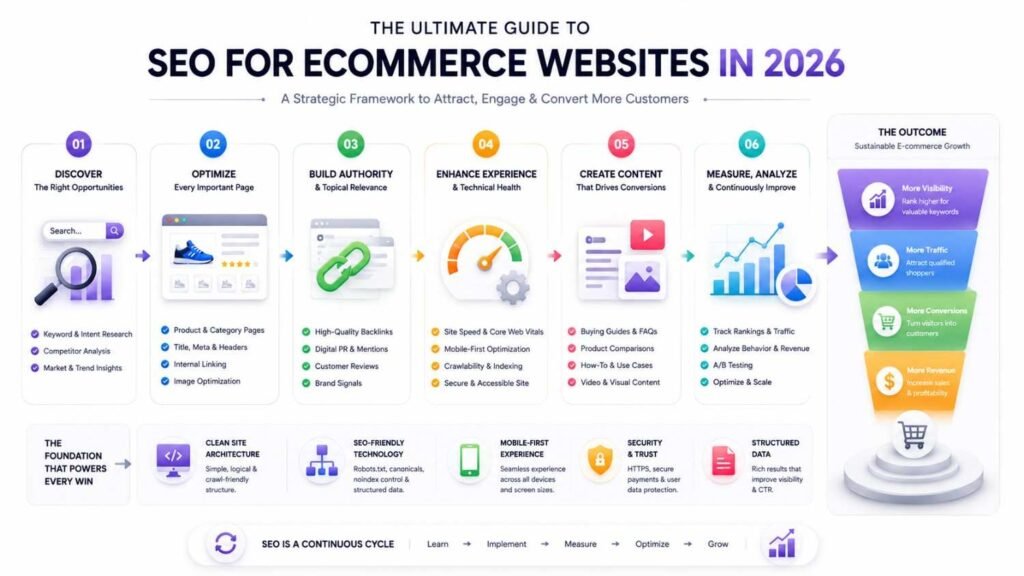
Product pages are at the bottom of the SEO funnel. This means people who visit these pages are usually close to buying something. So getting this layer right is really important. It matters for both rankings and revenue.
Here’s my approach to creating product pages:
* I write product descriptions. I don’t use what the manufacturer says. I talk about the benefits answer questions customers might ask and use target keywords naturally.
* I optimize title tags and meta descriptions. They include the keyword, product name and a reason to click.
* I optimize images. I use file names. Alt text that describe what the image shows.
Some other things I include are:
* Structured data. This includes Product schema with name, price and availability. I also add Review schema and FAQ schema where needed. This makes listings look better in search results.
* Page-level FAQs. These cover things like sizing, compatibility, shipping, returns and specifications. They answer questions people ask before buying and can appear as results in Google.
One thing many people forget in SEO for ecommerce websites is to optimize for what people are actually searching for, not just keywords. A product page should answer customers questions. It shouldn’t just repeat the product name. If you think about it this way it can improve both rankings and sales, from your Product Pages. Product pages are key. They help people make buying decisions.
Keyword Research for SEO for Ecommerce Websites : A New Way of Doing It
When it comes to ecommerce keyword research it is not the same as doing it for a blog or a service business. The main goal of ecommerce keyword research is to figure out what people are searching for when they want to buy something compare products or check out products.
Here is how I do my ecommerce keyword research.
* I match keywords to the type of page they belong to.
I put commercial terms on category pages because that is where they fit best.
I put long-tail terms on product pages because people are looking for something specific.
I put queries on blog content because people are looking for information.
* I also use modifiers like brand names, materials, sizes, colors and price ranges.
These modifiers are important because they show that people are serious, about buying something.
They are worth targeting because people are looking for something
* I look at what my competitors are doing.
I find areas where my competitors are not doing well. I can compete with them.
I also check where my competitors are ranking and where I am not ranking.
* I use Google Search Console to validate my research.
I often find that my existing pages are already ranking for keywords that I did not even try to target.
These are ways for me to optimize my pages and get better results.
For my research I use Google Keyword Planner to check how many people are searching for something.
I use Google Search Console to see how my existing pages are doing.
I use Ahrefs or Semrush to analyze my competitors and find areas where I can improve when I have the money to spend on these tools.
AI Content for SEO for ecommerce websites : What Works and What Doesn’t
AI-generated content is now a part of SEO for ecommerce websites.. How you use it really matters.
I use AI to write product descriptions and plan category content. It also helps group keywords. Speed up content creation for big stores. For websites with thousands of products it’s a must.
Here’s the thing: every piece of AI-generated content I publish gets reviewed. I check if its accurate, if it sounds like our brand and if its true. I also make sure it helps the user. Not search engines.
AI is super fast.. A good strategy, careful editing and real product knowledge are what make content work. Stores that win with content are using AI to save time not to skip thinking.
The stores doing well with content are those that use AI to work not to bypass the thinking. They know AI is a tool, not a replacement, for judgement.. That’s what makes their content perform.
Here is where you should start:
* Do a technical check for SEO for ecommerce websites for to find and fix problems with your ecommerce search engine optimization site. This includes problems that prevent search engines from looking at your ecommerce search engine optimization site problems that make your ecommerce search engine optimization site slow and problems with content.
* Figure out what keywords are right for your ecommerce search engine optimization site and map them to the pages.
* Make sure your important category pages are optimized first for ecommerce search engine optimization.
* Write product descriptions that match what people are looking for when they do ecommerce search engine optimization.
* Set up Google Search Console for your ecommerce search engine optimization site. Check it often to see how your ecommerce search engine optimization is doing.
* Add data to your product, category and frequently asked questions pages by SEO For Ecommerce Websites.
* Create a plan for your content that supports your category pages and helps you become an authority on SEO for ecommerce websites related topics.
Then you have to wait. Executing SEO for ecommerce websites takes time. It is not something that you can rush when you do ecommerce search engine optimization. You have to keep working at ecommerce search engine optimization and making improvements over time. This is the way to get growth from search engines for your ecommerce search engine optimization site. You have to be patient and keep working at ecommerce search engine optimization if you want to see results, for your ecommerce search engine optimization site. Ecommerce search engine optimization is not a fix it is something that you have to work on all the time for your ecommerce search engine optimization site.
Frequently Asked Questions
How does SEO for ecommerce websites shows results? SEO for ecommerce websites takes months to show results. Most sites see good improvements within three to six months of doing SEO for ecommerce websites work all the time.. This can be different for each site. It depends on how well known the site’s already how much competition there is and how well SEO for ecommerce websites is done.
Should I focus on category pages or product pages first? You should start with category pages. Category pages get the most people visiting them who want to buy things. They also help product pages by linking to them. Product pages are good too because they help people find what they want when they are looking for something
Do I need a blog for my ecommerce store? You do not need a blog now.. Having a blog can be helpful later on. It helps you become known for talking about topics. It also helps people find you when they are just starting to look for things to buy.. It helps you get links from other sites. The blog works with your product and category pages it does not replace them.
How does AI search affect SEO for ecommerce websites? AI is changing how people search for things. Now when you search for something you might see information about products and categories in the search results. Ecommerce sites that are easy to understand have information and are set up well are more likely to show up in these search results.
What’s the common technical SEO issue on ecommerce sites? The common problem is that there is too much of the same content. This happens when you have a lot of options for people to filter their search results. To fix this you can use something called tags control what pages are indexed and make special landing pages.
SEO for ecommerce websites in 2026 is, about thinking doing things consistently and taking care of your site all the time. You need to build a foundation make sure the right pages are optimized and keep making improvements based on what the data tells you. That is what works for ecommerce SEO for ecommerce websites.